China 2014

Pam travelled to Yunnan, China in the spring of 2014 to hunt for Primulas. Click image for more...

Primula Rediscovered

Primula bracteata and Primula bullata are found in their type locations after 125 years.

Near Lhasa, Tibet

How do you tell the difference between P. tibetica and P. fasciculata?

Primula ambita in the Wild

The first ever cultivated plant caused a stir at Chelsea earlier this year.

New Primula Book

The latest Primula book is a revision of the 106 species of Primula found in India.

Showing posts with label glossary. Show all posts

Sweet Caroline... section Carolinella

Where it began,
I can't begin to knowin'
But then I know it's growing strong

Was in the spring
And spring became the summer
Who'd have believed you'd come along


... Sweet Caroline.*
 
Primula cardioeides in Vietnam
In 1891, Augustine Henry married Caroline Orridge, though their marriage lasted only three years due to Caroline's tragic death from tuberculosis. Henry's job as a Customs officer lead him to Mengzi (modern Honghe) in southeastern Yunnan. By this time he was well established in plant collecting and his collection Henry 10735 from the forests SE of Mengzi was described as Carolinella henryi, named for his late wife. Though it was thought to be a new Genus, Pax later included it within Primula as section Carolinella and the species became Primula henryi. Unfortunately this name had already been used, so it was given the new name "Primula carolinehenryi" by S.O'Brien in the book "In the Footsteps of Augustine Henry". This name has since been corrected according to the International Code of Nomenclature to "Primula carolinehenryae" as it honors a women.

Primula carolinehenryae E00255693
courtesy Royal Botanic Garden Edinburgh
Two additional Henry collections were described from the area around Mengzi under the genus Carolinella: C. cordifolia (now P. partschiana) and C. obovata (now P. rugosa). The distinguishing feature of section Carolinella is the calyptrate capsule (the capsules don't split into 5 valves as most other species do, or by crumbling, but rather have a lid which lifts to expose the seeds). Some authorities recognise subgenus Carolinella which includes this section. The species in the section are distributed in SE Yunnan, S Guizhou, N Guangxi, S Hunan, N Guangdong, and N Vietnam.

P. rugosa, P. kweichouensis, P. wangii from Flora of China
In 2000 the paper "Pollen morphology in Primula sect. Carolinella (Primulaceae) and its taxonomic implications" was published, with SEM images of 7 species. It was found that there was considerable variation in the pollen morphology encompassing all 3 main pollen types (tricolpate, trisyncolpate and polycolpate) of the genus Primula and that this indicated that the group was heterogeneous.
Primula cardioeides pollen
From Pollen morphology in Primula sect. Carolinella (Primulaceae) and its taxonomic implications
In 2010 the paper "Circumscription of Primula subgenus Auganthus (Primulaceae) based on chloroplast DNA sequences" was published. The result of this study was that species assigned to subgenus Carolinella are dispersed among the species of subgenus Auganthus and that as defined, neither subgenus is monophyletic and it is inferred that the calyptrate capsule has evolved multiple times in the genus Primula. Also P. wangii which was initially placed in section Carolinella, but subsequently placed by Richards into section Monocarpicae, has an ambiguous position.
 
In 2015 the paper "Non-monophyly of Primula subgenera Auganthus and Carolinella (Primulaceae) as confirmed by the nuclear DNA sequence variation" was published and it is similar to the 2010 study. It was concluded that the calyptrate capsule has evolved independently at least four times in Primula. P. wangii was found to be close to P. kwangtungensis and P. kweichouensis and so together with P. levicalyx (not sampled) this seems to be a distinct group within the section. In 2014, the species P. hunanensis was described and placed in this group and the following key was presented.
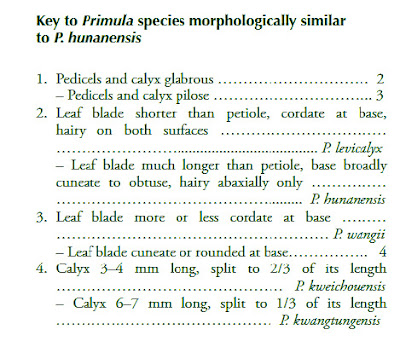
The species presently included in section Carolinella are: P. calyptrata, P. cardioeides, P. carolinehenryae, P. chapaensis, P. hunanensis, P. intanoensis, P. kwangtungensis, P. kweichouensis, P. levicalyx, P. partschiana, P. rugosa, and P. wangii. In future, we can expect that the section will be split to follow the results of genetic study. See the Species Gallery under each of these for more information.

* Don't recognise these lyrics? They're from Neil Diamond's "Sweet Caroline"
 

Pam Eveleigh © 2016
 

The Eye of the Flower - Annulate vs Exannulate


The eyes are the window of the soul.

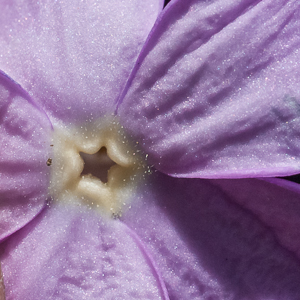
The eye of a Primula flower is its center which may be colored different from the rest of the corolla and which is the mouth or end of the flower tube containing the stigma or anthers (see Style Position).

In Primula, whether the flower is annulate or exannulate is an important characteristic to differentiate between species.
Close-up of the annulus in a Primula flower
Annulate means having a ring-like constriction (annulus) at the mouth of the flower. A different colored eye from the rest of the corolla does not indicate that an annulus is present. Some species even may be weakly annulate or sometimes exannulate. Exannulate is the opposite; no annulus is present. The best way to determine whether an annulus is present is to slice open the flower.

Slice open a flower to determine annulate (L) vs exannulate (R).
Examples of annulate Primula flowers 
Examples of exannulate Primula flowers


Primula Leaf Glossary

There are many terms that are used to describe Primula leaves and an understanding of what they mean is crucial to distinguishing species.


Lamina, or leaf blade, is the flat part of the leaf.
Apex is the point or tip of the lamina.
Base is the bottom of the lamina.
Veins appear as raised lines on the lamina. See Leaf Venation in Primula
Mid rib is the prominent vein which runs from the apex through the center of the lamina.
Margin is the edge of the lamina.
Petiole is the leaf stalk which attaches the leaf to the plant stem.

Each of these parts can vary in shape as shown the diagrams.

Leaf Shapes

Leaf Margins
Leaf Apex, Venation & Bases
Leaves can be petiolate (a petiole is present). Petioles can be distinct (clearly defined), indistinct (not defined) or winged (edged with a thin flange of tissue). It is important when extracting a leaf from a plant for imaging, that the petiole is intact. Remove the leaf by gently tugging downwards along the stem.

Winged petiole


Herbariums

Type specimens are (usually) dried and pressed plants, mounted on paper, stored in a herbarium and used to describe a new species. Associated with the specimen are details of its collection including where it was collected, when and by whom. Being able to access herbarium specimens is key to understanding what makes a species distinct and what variation the plants exhibit. Under Resources in the main menu of Primula World is a list of Herbaria that has collections of special interest to the study of Primula. This list is always being updated with more links, so check back frequently. If you know of a herbarium that should be on the list, please contact the webmaster. There is a great reference to the kinds of types at the New York Botanic Garden.


RBGE Herbarium image by Paul Macrae (CC BY-NC-ND 2.0) from Flickr

There a several great videos about herbariums below that are worth watching:


Resting No Longer, It's Spring!

Some Primula species spend the winter as conspicuous, above ground resting buds. The mature leaves die back in autumn and a new set of short leaves called bud-scales are grown closely together to form a protective layer around the growth point. These bud-scales are modified leaves that stay small, never growing to become normal leaves, and they often remain around the base of the plant through the growing season. The presence of absence of the bud scales can be an identifying feature to distinguish between species of Primula, such as small forms of Primula denticulata (with bud-scales) and Primula atrodentata (without bud-scales).


Primula magellanica in autumn, leaves dying back and resting bud forming

Primula agleniana in spring, bud scales still surround the new leaves and flowers

Primula denticulata in late spring, bud scales lie flat as the growth point expands with new leaves and flowers

Leaf Venation in Primula

Venation is the arrangement of veins in a leaf. This arrangement can be a distinguishing characteristic of Primula.

Pinnate Venation is vein arrangement in a leaf with one main vein extending from the base to the tip of the leaf and smaller veins branching off the main vein. This is the most common arrangement in Primula.
P. blattariformis
Pinnate venation in P. blattariformis

Palmate venation is vein arrangement in a leaf with the principal veins radiate out from a single point, most commonly where the leafstalk/petiole ends, and diverges out toward the edge of the leaf. Only a few Primula species have this arrangement such as: P. latisecta, P. palmata, P. vaginata, P. septemloba, P. alsophila, and P. geraniifolia.

P. palmata
Palmate venation in P. palmata

Style Position

A feature of primulas is their heterostyly nature. Almost all Primulas have a pin form (where the level of the stigma is above the anthers) and a thrum form (where the level of the stigma is below the anthers).
Thrum and Pin forms of Primula polyneura
 
Pin and thrum forms of Primula polyneura
As such, this wouldn’t then be something that would distinguish a species, but a few species are homostylous – that is the stigma and anthers are at the same level. There are long homostlye and short homostyle forms with the level of the stigma and anthers correspondingly high or low in the flower.
Homostyle Primula cuneifolia subsp. saxifragifolia

Homostyle Primula halleri

Examples of Primula homostyle species include: P. simensis, P. cuneifolia subsp. saxifragifolia, P. grandis, P. dumicola, P. klaveriana, P. septemloba, P. homogama, P. hookeri, prenantha, P. annulata. Some species can have heterostylous and homostylous forms including: P. obconica, P. chungensis, P. cockburniana, P. prolifera, P. halleri.