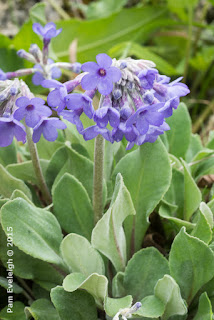
China 2014

Pam travelled to Yunnan, China in the spring of 2014 to hunt for Primulas. Click image for more...

Primula Rediscovered

Primula bracteata and Primula bullata are found in their type locations after 125 years.

Near Lhasa, Tibet

How do you tell the difference between P. tibetica and P. fasciculata?

Primula ambita in the Wild

The first ever cultivated plant caused a stir at Chelsea earlier this year.

New Primula Book

The latest Primula book is a revision of the 106 species of Primula found in India.

Farrer & Purdom 1915 Expedition to "Kansu"

Primula stenocalyx. 
Trying to understand Primula species is more than just looking at herbarium specimens and reading technical descriptions. Delving into the original plant collector's expeditions provides valuable insights into plant locations, habitats and field observations - and often it is pure and simple entertainment. In the course of trying to understand the Blue Nivalids, I traced the route of Reginald Farrer and his companion William Purdom in 1915 through the Datung Alps, now within Qinghai, not Gansu.

From "The Rainbow Bridge"
Surely you have heard of Reginald Farrer: plantsman, explorer and writer of excessive descriptive prose! Farrer wrote about this expedition, a continuation of his 1914 journey, in a series of articles in the Gardeners' Chronicle. His book “The Rainbow Bridge” is a full account of this expedition which started in Sining (Xining, Qinghai) and explored north and slightly east from there. For a few months, Farrer and Purdom made "Wolvesden house" their base and they explored as far to the east as Tien-tang (Tiantangcun) and as far north as Gan Chang Ssu (Ganchankou). Though there is a map in this book, in his “Report of Work in 1915 in Kansu and Tibet” in the Journal of the Royal Horticultural Society vol XLII, there is a crude map, but with better detailed locations.
"Wolvesden House, I feel, though abandoned again for evermore to mules and muleteers, remains perpetually my property Dear little house, how dull you sometimes were; how desirable you always are. Sitting up there, far away, lost and lone in your deep grove of the great Thibetan Alps. Those who may wish, (in days I hope still distant) to commune with my ghost must take a long journey, to where it will be found cheeping and chittering wanly round the mud-plastered walls of Wolvesden, rather than on the Schneeberg or the Tombia or even Moncenisio." From "the Rainbow Bridge"
The plant that I was investigating is Primula farreriana, but there are other Primula species to be found in the same area and Farrer & Purdom collected most of them. Unfortunately Farrer has an annoying habit of calling the plants sometimes by their Latin Name and sometimes by his own English Name. It can be difficult to decipher which plant he is talking about! Primulas found on this expedition include; P. farreriana (My Own Primula), P. gemmifera (Welcome), P. pumilio, P. reginella (Little Queen), P. stenocalyx (Clusterbeauty), P. tangutica, P. urticifolia (Pretty One), P. woodwardii (Imperial), P. erratica (Lavandine, P. stenocalyx dealbata). However, his articles are certainly worth reading!

The Russian explorer Nikolai Przewalsky (Przhevalsky) had been to this region in 1880 and made several Primula collections which were then described by Carl Johann (Ivanovič) Maximowicz. These include P. flava, P. pumilio, P. stenocalyx and P. urticifolia. There is an interesting map which shows Przewalsky's routes in the area, part of a set made by Filchner in  "Kartenwerk der erdmagnetischen Forschungsexpedition nach Zentral-Asien 1926 - 28". From this you can see that Farrer & Purdom's route overlapped with Przewalsky's.
Farrer & Purdom 1915 route
How well Farrer sums up the feeling of coming back from a botanical expedition : "Indeed, the Rainbow Bridge has long since reached its bourn; we have long been roaming at ease on the far golden shore, and found it barren; now, upon a bridge of sighs we must embark upon a return journey across the abysm of tears towards the desolated shell-holes and slag-heaps of the present days. Yet do not be misled if I seem to grizzle and peeve as I return. For there is laughter in every sigh and complaint, and a twinkle of not unkindly derision that any such should be emitted." from "The Rainbow Bridge".

I am looking for images of Primula species from this area of Qinghai/Gansu. Please contact me if you have any or if you are planning a trip to the area in the future.

The Truth about the Blue Nivalids (P. longipetiolata)


Primula longipetiolata is considered a synonym of P. limbata by Halda and Richards, and a synonym of P. optata by the Flora of China (FoC). The holotype specimen resides at Universität Wien, Austria and consists of one plant, quite faded, but there is also a sheet at Royal Botanic Garden Edinburgh which consists of three leaves and a flower (not a whole plant). One of the leaves retains the color of the midrib and petiole, which is red in live plants. Telling are handwritten notes on both sheets from W.W. Smith, the Edinburgh one says "I have seen complete specimen - cotype in Herbarium Vienna. I do not match it with any other Nivalis form. Dr. Handel Mazzetti supports limbata - which will not do." and the Vienna one says "P. longipetiolata. I think this is sp. nov. It is not limbata, Balf.f. et Forrest." When Smith and Fletcher wrote about the Section Nivales in their monograph, Smith reluctantly placed P. longipetiolata under P. limbata but stated that "Dr Handel-Mazzetti regards it as too closely approaching P. limbata."
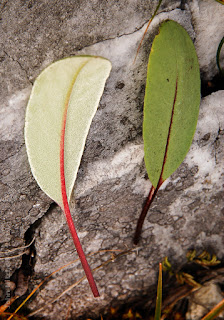
Primula longipetiolata. Long red petioles and farina thick around the under margin
The more current Chinese online version of the Flora of China has P. longipetiolata listed as distinct. In the discussion it is distinguished from P. limbata and P. optata by the leaf shape and longer petioles (also calyx lobes and number of whorls). Also mentioned in the discussion is P. tsiangiae, which is listed as a synonym though it was not mentioned in the published FoC and Richards lists as a synonym of P. limbata. This is a confusing species which was collected in fruit and initially compared with Primula orbicularis. It was found in the same area as P. longipetiolata, near Kangding (now Garze). It has leaves with an attenuate base merging into a long petiole which look different to those pictured above but which match the holotype. However, once we see P. longipetiolata in cultivation, it becomes apparent that this species produces both leaves shapes pictured - those with an attenuate base are produced early and those with an obtuse base are produced later and are more evident in the Fall. It is convenient then to lump P. tsiangiae into P. longipetiolata until there is evidence otherwise. There is no indication that either P. limbata or P. optata produce both leaf shapes.
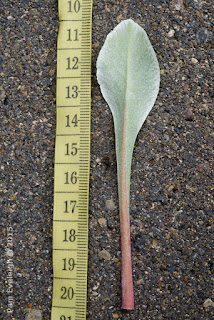
Primula longipetiolata leaf shape variation
The type location for P. longipetiolata is the La-ni-ba, SW of She-to, Sichuan. I have researched the location of this pass and it is just 20kms away and on the same mountain range as the Zhedou pass (30° 4'27.11"N 101°48'15.00"E), where most of the the wild images in the Species Gallery were taken. Additional images were taken at Ji Chou Pass which is on the southern end of the same range, about 70kms away from the type location. The type location for P. limbata is 350kms to the SW of P. longipetiolata, on the Tibet-Yunnan border. The type location for P. optata is at Siku (Zhugqu) 500kms away from P. longipetiolata to the NE in Gansu.
Relative type locations
 
Zheduo Pass, habitat of Primula longipetiolata
Note that Smith refers to subsequent collections by Rock in Sichuan which he says confirms the opinion of Handel-Mazzetti to lump P. longipetiolata with P. limbata. These sheets are not online and so I have not taken them into account. I think P. longipetiolata stands on its own as a distinct species from the information that I have and have listed it separately on PW in the Species Gallery.

This post is one in a series about Chinese blue nivalids. See the introduction post.

Recent New Primula Species

Primula hydrocotylifolia.
The New Year is a good time to reflect on what is new in Primula. In my Original Description Project, the list of all Primula species is a moving target. In particular, there have been several new Chinese species discovered and described recently but new species aren't limited to China. New species include:

Primula anthemifolia G.Hao, C.M.Hu &  Y.Xu - This tiny species has leaves which resemble those of the Genus Anthemis (pinnately dissected) and was found in Sichuan. It is a member of section Aleuritia, subsection Glabra.

Primula dejuniana G.Hao, C.M.Hu & Y.Xu - Discovered in Sichuan, this species is a member of section Petiolares, subsection Davidii and resembles P. davidii and P. tenuituba but is distinguished by the leaves.

Primula hunanensis G.Hao, C.M.Hu & X.L.Yu - This species is named for the province of Hunan where it was discovered. It is a member of section Carolinella which is noted for its calyptrate (opening by a lid) capsules and is similar to Primula levicalyx.

Primula hydrocotylifolia G.Hao, C.M.Hu & Y.Xu - Discovered in Sichuan and very similar to Primula veitchiana but is smaller and less floriferous. See above and the Species Gallery for more images.

Primula pelargoniifolia G.Hao, C.M.Hu & Z.Y.Liu - A yellow flowered species discovered in Chongqing and most similar to members of section Cortusoides. Named for the "Geranium" like leaves (Pelargonium).

Primula subpyrenaica Aymerich, L.Sáez & López-Alvarado - Discovered in the Pyrenean range in the NE Iberian Peninsula, this species is in section Auricula and is closely related to Primula auricula.

Primula wawushanica G.Hao, C.M.Hu & Y.Xu - The paper for this is accepted but not yet published at this time. It was discovered in Sichuan and is a member of section Petiolares, subsection Davidii.

There are also changes to the taxonomy of Primula. They include:

Primula bullata Franch. var. bracteata (Franch.) P.Eveleigh, J.Nielsen & D.W.H.Rankin
Primula bullata Franch. var. forrestii (Balf.f.) P.Eveleigh, J.Nielsen & D.W.H.Rankin

From the book "The Genus Primula L. in India":
Primula bella Franch. var. moschophora (Balf.f. & Forrest) S.K.Basak & Mati
Primula calderiana Balf.f & R.E.Cooper var. strumosa (Balf.f. & R.E.Cooper) S.K.Basak, Maiti & Hajra
Primula firmipes Balf.f. & Forrest subsp. subansirica (G.D.Pal) S.K.Basak & Maiti
Primula tanneri King var. nepalensis (A.J.Richards) S.K.Basak & Maiti
Primula tanneri King var. peralata (W.W.Sm. & Fletcher) S.K.Basak & Maiti

Happy New Year and Best Wishes to All in 2016!


The Truth about the Blue Nivalids (P. melanops)

Habitat of Primula melanops.
Primula melanops is a name which many people know from cultivated plants, but what is the true species? It was first collected by Handel-Mazzetti in Muli, north of Yanyuan, in 1914, but he didn't describe the plant until 1924 using the name P. leucochnoa. By then, Kingdon Ward had also collected the same species (in 1921) from Muli, very close to the same place and it was then described by Smith and Ward in 1923 as P. melanops, and so that name has priority. There is no doubt they are the same species. In 2009, I saw plants which are this species, but unfortunately the flowers had already gone over. What I would have expected to see are flowers of "deep Tyrian purple, black in the centre" as stated in the original description.

Pam photographing Primula melanops in Muli
Richards includes P. melanops in is his broad definition of P. chionantha, a variable complex of plants, stating that the character used to distinguish between P. melanops and P. chionantha is primarily the color of the farina, and is of no consequence. The original description of P. melanops compared it with P. sinopurpurea but the differences were that it was smaller, white farinose on the leaves, flowers deep purple with a black eye and a long capsule to 2.5cm. The plant in flower is 10-15cm and 35cm in fruit.
Primula melanops in Muli
I don’t have pictures of true P. melanops in flower either in the wild or grown from seed collections from Muli. Because Richards lists it as part of P. chionantha, plants from many different locations have been identified as this species. For example, plants from the Beima Shan in NW Yunnan have been identified as P. melanops but other species that are part of the Blue Nivalids have type locations in this area, so it is more likely that the plants belong to a related species, not P. melanops. I have listed Primula melanops separately in the Species Gallery, where you can find links to the herbarium sheets, but Richards’ point may be valid.

This post is one in a series about Chinese blue nivalids. See the introduction post.

The Truth about the Blue Nivalids (P. farreriana)

Primula farreriana was collected by Farrer and Purdom in the “Ta-Tung Alps, Kansu” in June and July, 1915 (F. 560, Primula No. 29). Ta-tung is a small mountain range east of Qinghai Lake, Qinghai and could be considered a southern extension of the Quilian (Qilian) mountains. Farrer is well know for his descriptive prose, and there are several writings about the 1915 expedition and the Primula itself. His book “The Rainbow Bridge” is a full account of this expedition which started in Sining (Xining, Qinghai) and explored north and slightly east from there. For a few months, Farrer and Purdom made "Wolvesden house" their base and they explored as far to the east as Tien-tang (Tiantangcun) and as far north as Gan Chang Ssu (Ganchankou). Though there is a map in this book, in his “Report of Work in 1915 in Kansu and Tibet” in the Journal of the Royal Horticultural Society vol XLII, there is a crude map, but with better detailed locations.

Farrer's full description of his discovery of Primula farreriana is worth reading, but who could not covet a plant with flowers "And they are of a loveliness singular and phantasmal in their family, very large and ample and round-faced, of a faint blue lavender so subtle as to be almost a French grey, gradually suffused with a white radiation from the misty bull's-eye of intense black-purple at their throat, which continues down the tube inside and out"? In Farrer's famous book "The English Rock-Garden" there is a black and white photograph taken by Purdom of Primula farreriana in the wild.

Primula farreriana was described by Balfour in 1916 and there are type specimens at the British Museum, Kew, two at Royal Botanic Garden (here and here) and the Smithsonian. Farrer's field note, tells us that this species likes shady crevices (in small soil pockets) on either limestone or granite and that it can form large colonies. This species is more robust that other nivalids with thick stocks of sheathing petioles and bud scales, the leaves are elliptic or oblong-elliptic with an obtuse or subacute apex and with an obtusely denticulate margin. The underside of the leaves is covered in thick white farina, as is the apex of the scape and the pedicels. The flowers are pale lavender-blue, prominently annulate and with a dark purple eye and tube. The bracts are linear with a broad base and the calyx is tubular campanulate and tinged with purple.

It is distinct from other similar species by the corolla lobes which are emarginate (notched), the widely winged petioles, the prominent annulus, long bracts and dark colored calyx. Primula woodwardii grows in the same range and has entire corolla lobes and is more pink in color. Apparently P. farreriana has not been in cultivation. If you have a picture of this species, please contact the webmaster.

This post is one in a series about Chinese blue nivalids. See the introduction post.