![]() |
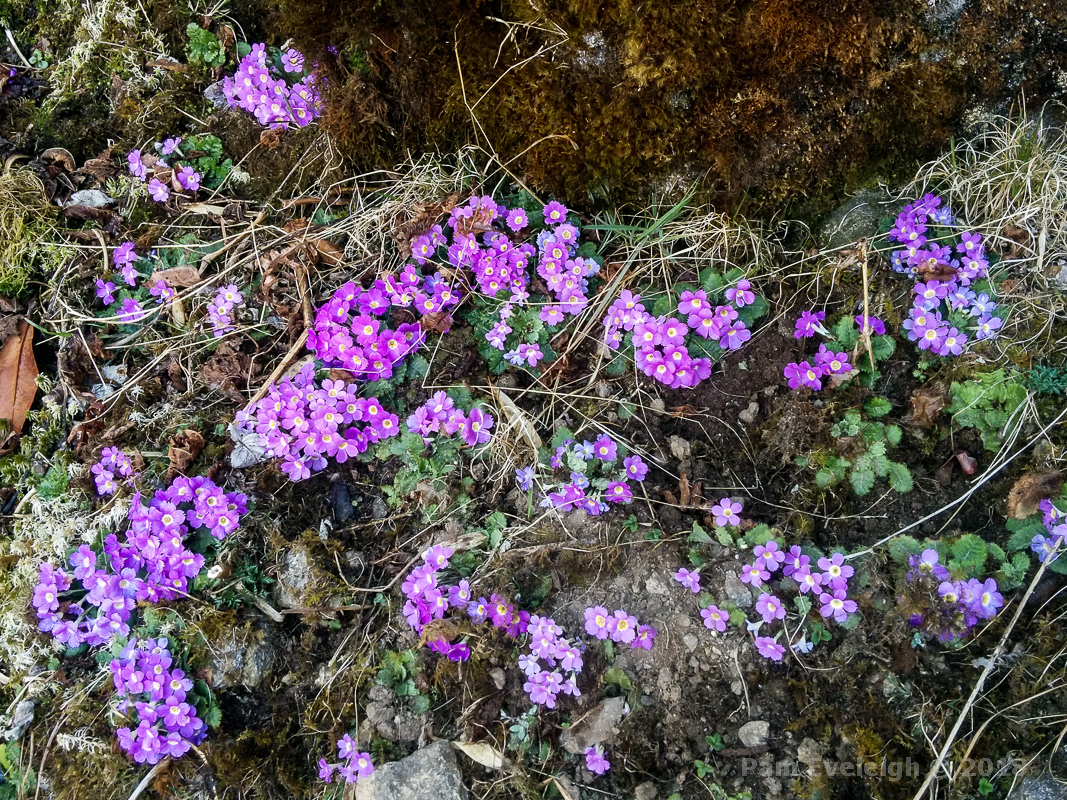
| Primula luteoflora |
Recent New Primula Species (2018)
Two Primulas from Everest Epedition of 1921
In 1921, the British Mount Everest reconnaissance expedition set off to explore possible routes up Everest. Since Nepal was closed to foreigners at the time, the expedition approached through Sikkim, into Tibet's Chumbi valley, then west to Tingri Dzong (north of Everest), which they used as a base. From here members explored south for routes up Everest including the Rongbuk valley, and Nangpa La. The expedition naturalist, A. F. Wollaston (image above, standing, at left) collected flora and fauna specimens which included two new Primulas; Primula buryana named for one of the expedition members, C. K. Howard-Bury, and Primula wollastonii named for himself. The route he travelled was a loop to the west of Mount Everest, first to Nyenyam (Nyalam) and then through Lapche to the Rongshar valley.
![]() |
| Primula wollastonii |
"Crossing a pass to the East of Nyenyam, we camped on a level spot covered densely with white primulas (P. buryana) six to eight inches high; and inch or two of snow fell during the night, and so white are these flowers that it was difficult to see them against the snow. Near the top of another pass we found at about the same altitude, 15,000 feet, another primula (P. wollastonii) with three to six bells on each stem, the size of a small thimble, of a deep blue color, and lined inside with frosted silver."
![]() |
| Primula buryana |
![]() |
| Map of area Lapche-Trintang |
![]() |
| Primula buryana var. purpurea |
Primula sachalinensis
![]() |
| Primula sachalinensis: |
![]() |
| Primula sachalinensis at Magunant mud volcano |
![]() |
| A white form growing at Magunant mud volcano |
Primula sachalinensis has been considered a variation of Primula farinosa and certainly it is close, but the base of the bracts are gibbose. Regular Primula farinosa does not grow on Sakhalin and Bukhteeva³ noted that these plants growing on freshly ejected mud substrate differed from normal Primula farinosa to such an extent that the classification of Primula sachalinensis as a distinct species, endemic to Sakhalin, was justified. Kovtonyuk⁴ included Primula sachalinensis in a genetic study and confirmed it was distinct and more closely related to Primula mistassinica, Primula modesta and Primula incana.
¹ Original description on page 61 within the PDF of Bot. Mag. (Tokyo) 1932, xlvi.
² Original description Fl. Korea (Lee) 1159, without type. 1996.
³ Bukhteeva, A.V., Primula sachalinensis Nakai, the Primula species of the Maguntan volcano, Bot. Zh., 1960, vol. 45, no. 5, pp 746-748.
⁴ Kovtonyuk, N.K. and Goncharov, A.A., Phylogenetic relationships in the Genus Primula L. (Primulaceae) inferred from the ITS region sequences of nuclear rDNA, Russ. J. Genet., 2009, vol. 45, no. 6, pp. 663-670.
Studying Primula gracilipes
When in Nepal in the spring of 2018, I had a chance to study Primula gracilipes in detail. This species blooms early - I saw it in April. It belongs in section Petiolares and is closely related to several other species which have a similar loose cushion habit and dimorphic leaves (two different leaf shapes are produced depending on the time of year). One of the key features to see when identifying this group of species is the flower scape (or lack of). I used a technique where leaves were removed from one side of the plant to observe this and those leaves were then laid out for imaging. What follows are some of the images I took to document this species. Click on the images for larger sized versions.
![]() |
| An example plant is removed from the soil and measured. |
![]() |
| The plant is shown upside down to show the root structure and the absence of basal bud scales |
![]() |
| Now you can see the internal structure of the plant. |
![]() |
| You can clearly see that there is no scape, but that each pedicle comes from the base of the plant. You can see the bracts which are broad at the base and taper to a point. |
![]() |
| P. gracilipes produces two different leaf shapes. The form with the long petioles are produced late season so I searched the base of several plants to find last years old leaves. |
![]() |
| At a lower elevation I found plants which had bloomed earlier and were now producing this second leaf shape. |
![]() |
| An example of farina on new leaves (right) |
![]() |
| The flowers are shown from the side to see variation in the calyx. The flower on the right is a "thrum", and you can see the bulge in the flower tube where the anthers are located. |
![]() |
| Farina on the back of the flowers |
![]() |
| Folding a black velvet cloth, I make a place to hold the flowers upright to show the face. This allows me to show variation in color and shape. |
![]() |
| Using a sharp razor blade, I cut open a flower. This is a "pin" where the anthers are below the stigma. |
![]() |
| This is a "thrum" where the anthers are above the stigma. |
![]() |
| At lower elevations, plants were forming seed capsules. |
![]() |
| Variations in color. |
![]() |
| Pale color variation. |
![]() |
| Dark color variation. |
![]() |
| Habitat. |
![]() |
| Habitat. |
![]() |
| Habitat. |
![]() |
| P. aureata (left), P. gracilipes (right). |
![]() |
| P. gracilipes (top), P. deuteronana (bottom). |
![]() |
| Comparison of P. deuteronana (left), P. gracilipes (right). |
Recent New Primula Species (2017)
![]() |
| Primula zhui (by H. B. Ding) - from the original publication |
The Mysterious Primula of Omta Tso (Bhutan)
![]() |
| Omta Tso, Bhutan |
It was initially compared with Primula griffithii and P. tanneri but it was distinguished by leaves which are rounded at the apex, bluntly crenulate at the margin and a calyx which is sparsely farinose and glandular. The flowers are described as rich purple.
![]() |
| Primula tsariensis |
![]() |
| Primula species of Omta Tso, Bhutan |
![]() |
| Omta Tso area, Sherriff 1937 - hybrids found along the orange route |
![]() |
| Color variations of P. calderiana X P. strumosa |
So are the plants at Omta Tso P. tsariensis or are they P. strumosa?
The most obvious differences between the two species are that P. calderiana / P. strumosa smells "disagreeable", and has farina present on the bud scales, and on the upper scape, calyx and pedicels whereas P. tsariensis is not noted for its smell, has efarinose bud scales and only trace amounts of farina on the pedicels and calyx.
![]() |
| Bud scales - (L) no farina, P. tsarieneis, (R) with farina, P. strumosa |
The Black Mountain (Bhutan) - Primulas and Problems
![]() |
| Durshingla © Darlo Letro |
Ludlow and Sherriff (L&S) visited Bhutan several times and Sherriff's 1937 expedition was specifically to Durshingla which he called Dungshinggang. He found no new Primula species there but he was able to recollect known species.
![]() |
| Sherriff's route up Durshingla in 1937 |
Primulas & Problems
1. The most interesting species found on Durshingla is Primula chasmophila and, so far, it is only found on this mountain. Cooper first discovered it in September and his herbarium specimen was sparse, so it was described from cultivated plants grown from seed. Sherriff collected it on the mountain ridge near the Nabzi La. Though it was scarcely in flower, he noted its deep, rich blue violet color, red eye and its cliff ledge habitat and compared it with Primula umbratilis, a much more widespread species that is also found on the mountain (Cooper 4822). What to photograph if you see this species? Variations in flower color, details of the hairs on the flower scape, leaf study.
![]() |
| Primula chasmophila L&S 3301, courtesy Royal Botanic Garden Edinburgh |
![]() |
| Primula hopeana |
![]() |
| Primula elongata |
![]() |
| Characteristics of P. bhutanica. Can you find plants like these in a population of P. whitei? |
![]() |
| Primula bracteosa, courtesy Royal Botanic Garden Edinburgh |
![]() |
| Primula tenella usually has 1 flower and a bract. |
Other Primula species found on Durshingla: P. atrodentata, P. munroi, P. calderiana, P. megalocarpa, P. waddelli, P. bellidifolia, P. obliqua, and P. glabra.
I am uncertain of the exact location of Nabzi La on Durshingla. If you have the GPS coordinates for it or a GPS track for the route up the ridge, please contact Pam. If you are interested in more details of these species or locations, or if you have images of these species, please contact Pam.
A video of Foresters in Bhutan https://leythro-darlo.blogspot.ca/2017/02/conservation-journey-video.html
Spring is here, almost (Primula denticulata)
This blog post was originally written over 3 years ago! Though it is now late in 2020, and the pandemic is still with us, looking ahead we can hope that life returns to normal soon. Primula denticulata is surely a wonderful symbol of that hope.
One of the most photographed Primula in the wild is the showy and locally abundant species, Primula denticulata. It is distributed across the Himalaya from Afghanistan through to Sichuan, but it was first collected in Nepal. It was described in 1805 by James Edward Smith and the original description includes a painting. The type specimen LINN-HS 271.2.2 (Herb Smith) was collected by Dr. Buchanan and resides at the Linnean Society. The type location is "the moist parts of the hills about Chitlong in Nepal, flowering from February to April". Buchanan's journey is detailed in "An Account of the Kingdom of Nepal", written in 1819. Chitlong (27°38'59.27"N 85°10'12.17"E) is very near to Kathmandu, though overlooked by plant enthusiasts as they head for more popular trekking areas.
This species varies across its distribution and authorities have disagreed on the distinctions, creating numerous species which have since been lumped into P. denticulata including P. adenophora, P. aequalis, P. alta, P. cyanocephala, P. harsukhii, P. hoffmeisteri, P. limnoica, P. paucifolia, P. platycrana, P. sinodenticulata, and P. telemachica. A one time even P. capitata and P. erosa were thought to be synonymous. Primula cachemiriana, described from cultivated plants, persists as a name given to plants covered with dense yellow farina. Adding to the confusion are dwarf states which resemble P. atrodentata but can be distinguished by the presence of persistent basal bud scales which were once part of the winter resting bud. 
Primula denticulata color forms
![]() |
| P. denticulata basal scales flatten to reveal true leaves and flower buds |
Many garden selections have been made. The compact flower heads are composed of numerous erect flowers in shades of purple, pinkish-purple, reddish-purple or white. It is winter hardy in my garden in Calgary, Canada though it does resent water around the resting bud in winter. It is easily grown from seed, which is produced in copious amounts and can be vegetatively propagated by splitting crowns or by root cuttings.
![]() |
| Masses of plants in Bhutan |