Have you ever seen the book “Seeds:Time Capsules of Life” by Kesseler & Stuppy? It’s a gorgeous coffee
table book of false-colored scanning electron microscope (SEM) images of seeds.
These types of images can show wonderful detail at the microscopic level and
give us more information to help distinguish between species. Primula seeds
aren’t quite as fascinating as some of the seeds depicted in the book, but they
do have minute details that make them interesting (see the SEM image above of a Primula seed that I false-colored ). And though you can buy old scanning electron microscopes
on ebay,
this technique is out of reach for the majority. However, taking optical images
of seeds can be done with minimal equipment, just as long as you are able produce
magnification in the range up to 10X. This can be done with specialized lenses
(like Canon’s MP-E 65mm), by reversing wide-angle lenses (like 24mm or 20mm)
with a reversing ring (like Nikon’s BR-2A) or by attaching microscope lenses to
the camera directly with an adapter (see this page on photomacrography.net).
Or you can take images through a microscope using a camera adapter. If you want to add a scale
to your image a micrometer slide is useful.
 |
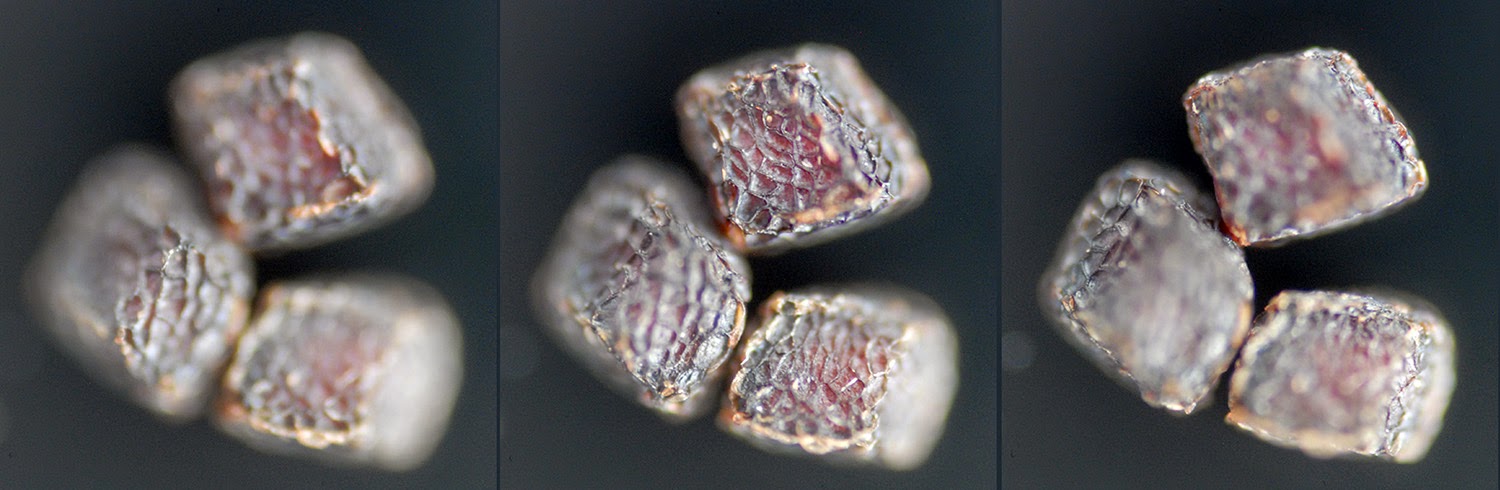
| Focus slices |
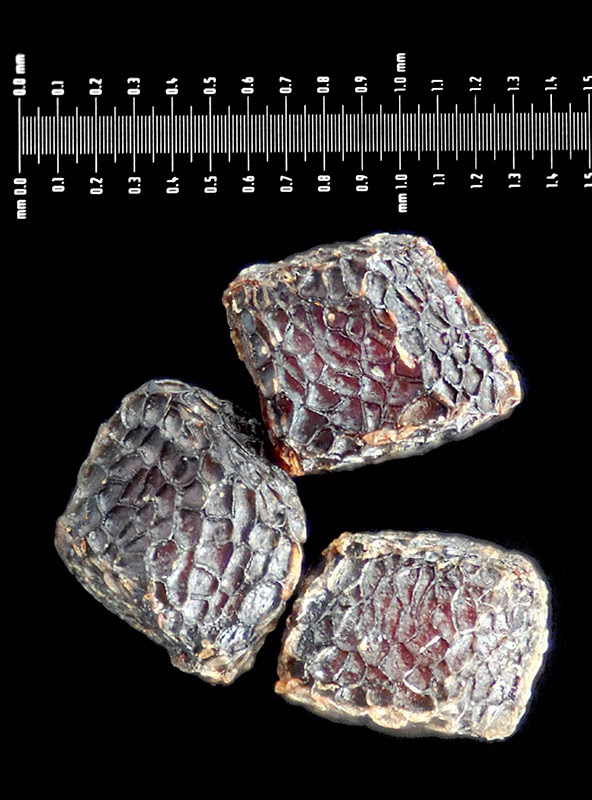 |
| Primula brachystoma seeds focus stacked |
The problem you encounter when taking magnified seed images is that the whole seed will not be in focus in a single image because of the narrow depth-of-field. In order to create an image with the whole subject in focus, we use a processing technique called "focus stacking". There are many good programs that do this as listed in the link, but I happen to use Zerene Stacker. This program combines the in-focus parts of multiple images taken with overlapping focus points to create an image that has the subject completely in focus.
So why would we want to look closely at Primula seeds?
 |
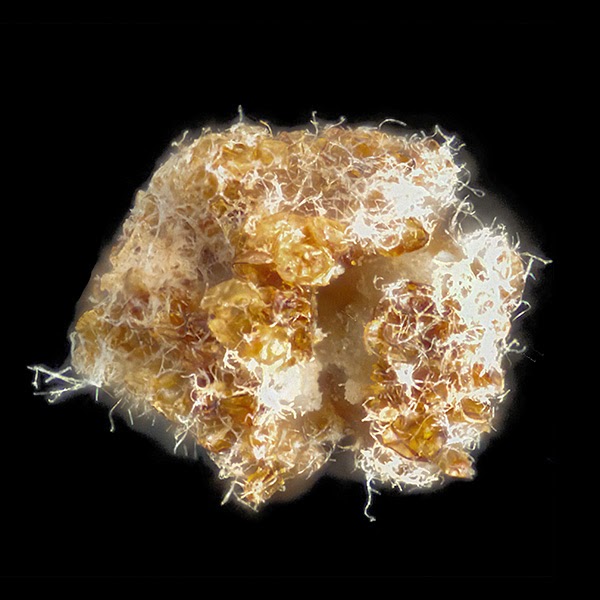
| A broken Primula agleniana seed attacked by fungus |
Do you know what you area getting in a package of seeds? Even if you don't take an image of your seeds, looking at the seeds closely may reveal that there is more than one type of seed in a package, there is chaff or sand, or that some seeds are broken and molding. Keeping a images of your seeds allows you to compare with seeds that are supposed to be of the same species and can uncover misidentifications.
And it's really fun to uncover the hidden beauty of Primula seeds!